 Rank Your Favorites
Ancient Egyptian Names Beyond Cleo
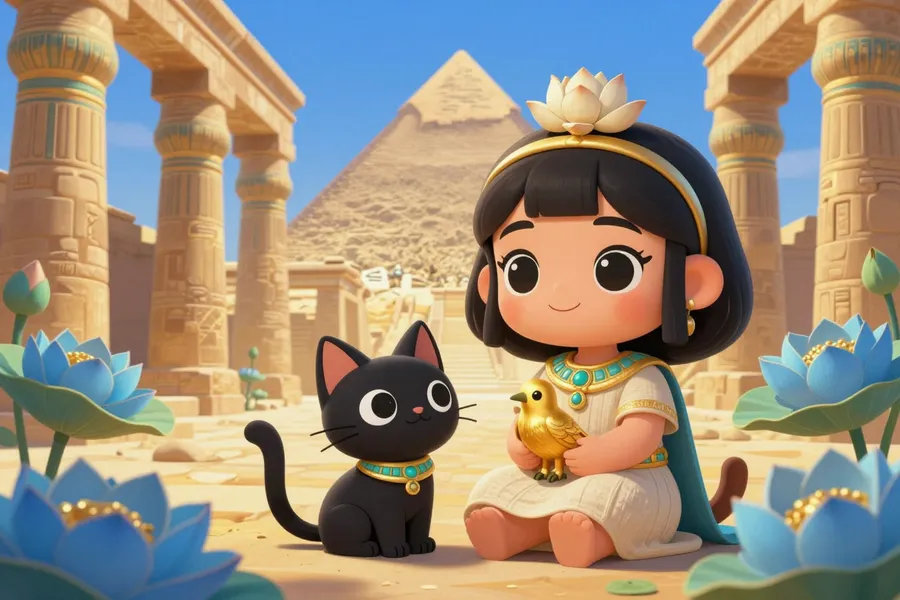
I almost named Hazel Cleo. I liked the bright, clipped sound and the way it seemed perfectly at home on a little kid without asking her to remain one forever. On the hospital form, I paused over it before writing the name we had chosen. Cleo stayed with me, though, partly because it opens a door I wanted to walk through: the history of Egypt, its queens and rulers, and the religious world around them. Cleopatra is the connection many American parents will recognize first. Cleo also has a Greek root, which is part of what makes the name such an interesting place to begin. It can lead you toward ancient Egypt without suggesting that every name connected to that history began in the Egyptian language. Some of the names that follow are as compact as Cleo; others ask you to enjoy every syllable.
Cleo sounds complete to me, not like a placeholder for a longer name. It has the ease I wanted when I was naming Hazel, with a royal connection tucked inside a name a child can say quickly. Parents who like Cleopatra's history but want something less formal might find the short form especially appealing. The Social Security Administration counted 516 girls named Cleo in 2025. Selene and Isis, two other names in this conversation, had different counts that year.
| Girl's name | SSA births in 2025 |
|---|---|
| Cleo | 516 |
| Isis | 128 |
| Selene | 469 |
Selene is another Greek name worth considering if Cleo appeals to you. It is the name of the Greek moon goddess, and its flowing sound offers a softer alternative to Cleo's clipped finish. Thea is a short form of Dorothea, meaning "gift of God." Alexander, meanwhile, means "defender of mankind." I like the way these names let a family follow a sound or a Greek connection in different directions without treating them as ancient Egyptian words. Selene feels graceful beside the spare Cleo; Thea shares some of Cleo's lightness. Alexander has a fuller, more formal presence, with plenty of room to stand on its own. A shared connection to Greek naming does not make these names interchangeable, and that is part of the pleasure of looking at them together.
At the royal court
Nefertari, usually said nef-er-TAR-ee in American English, has a long, graceful rhythm that doesn't need to be trimmed down to justify its place on a birth certificate. If you want the full name, use it. The connection to an Egyptian queen gives a child a story to discover, but I would choose Nefertari because I loved saying it, too. There is pleasure in the way the name unfolds, especially if the short, quick sound of Cleo leaves you wanting something more expansive.
Nefertiti, nef-er-TEE-tee, has a lighter finish but an equally commanding presence. I can imagine a parent drawn to the queen's name for its sound as much as its history. It has a lively rhythm that makes it fun to say aloud, and its meaning gives a family another part of the story to share. Beside Nefertari, it shows how different two queenly names can feel.
Tia offers a quieter choice among names connected with Egyptian history. It can also stand independently as a short form of Teresa. I like that a child named Tia could explore the Egyptian connection without having it announced every time she introduces herself. That isn't a better way to carry history than Nefertiti's unmistakable sweep. It is simply a different one. If you are deciding between them, listen to how each sounds with your last name: Tia moves quickly, while Nefertiti takes its time.
Ramses, RAM-seez, is the royal choice I would put on a boy's short list. Its meaning refers to Ra, the sun god, and it carries the weight of more than one ruler rather than pointing to a single life. There is no mistaking its historical identity, but the sound itself is approachable. I like the contrast between that grand association and the straightforward way the name comes off the tongue. It has presence without needing an elaborate introduction.
A royal name doesn't have to shrink itself to be wearable.
- Margot Reyes
Names with divine stories
Maat was both a goddess and a principle, a way of understanding truth, justice and order. The name is often said mah-AHT in the United States. Its spare appearance on the page holds a serious idea, and that contrast is part of its appeal. If Cleo attracts you because it is short but substantial, Maat offers another way to get both qualities. Its sound is distinct from Cleo's, though, and the ideas behind it give the name its own center.
Bastet, often BAS-tet, may catch the eye of a family that loves cats, but I wouldn't reduce the goddess to a cute pet reference. Bast is another form of her name. Bastet has the more expansive sound; Bast is brisk and blunt. Try saying each with the surname you have in mind. The difference is more than a matter of length: Bastet has a little bounce at the end, while Bast makes a firm stop. Neither needs to be dressed up to be memorable.
Osiris, oh-SY-ris, has an elegant sound for a name with such weighty associations. The connection to the afterlife and resurrection may be the part that stays with you, or you may be drawn first to its flowing sound. I would let each child have a name chosen for its own story, rather than treating siblings as a matched set of mythological figures. Osiris has enough character to stand on its own.
Horus and Anubis carry their own distinct mythological associations.
Merit is another choice connected with Egyptian history. In English, of course, merit is also an ordinary word about worth or achievement. That double life might be exactly what attracts you, or it might pull your attention away from the older connection. I like names that invite a second look, but a word name can feel different when you imagine using it every day. Merit is worth considering for its sound as well as the ideas an English-speaking listener may bring to it.
The complicated case of Isis
Isis, EYE-sis, has a long history that predates the terrorist organization known by the acronym ISIS. In the United States, many people will nevertheless hear that modern association, and parents deserve to consider the conversations it could bring. People who already bear the name also deserve the courtesy of having it heard as their name, not as a commentary on an organization. I wouldn't tell every family to cross it off, and I wouldn't pretend the association doesn't exist. The goddess's story remains substantial; so does the context in which a child would introduce herself. If you love the name, talk honestly with the people making the decision with you about what that context could mean in everyday life. The answer may be personal, and it need not diminish the history that drew you to Isis in the first place.
Rulers and other possibilities
Seti, Menes and Akhenaten all point toward Egyptian rulers, but they make very different impressions. Seti is compact and quick; Menes has a softer finish. Akhenaten has a grander sound and an immediate tie to a particular ruler, so it may suit a parent who wants the historical reference to be unmistakable. None needs to be made more familiar by a creative spelling. I would put Seti beside Ramses on a list if I wanted a royal name with a shorter sound, and keep Akhenaten for a family that loves the full sweep of it. Menes sits somewhere else entirely for me, gentler in sound without losing its connection to history.
Anippe and Sekani also turn up in collections of names connected with Egyptian history. Anippe has a flowing, vowel-led sound; Sekani has a lively rhythm and a strong opening. I wouldn't treat them as interchangeable substitutes for better-known royal or divine names. Each creates a different impression when you say it, and each deserves to be considered on its own. If your list has become crowded with names you admire in theory, hearing Anippe and Sekani alongside your favorites may help you notice which sounds you actually want to live with.
Egyptian Christian connections
Egypt's Christian history offers another route into naming, and those connections should not be folded into the ancient Egyptian language. Anthony comes from the Roman family name Antonius and can call to mind the Egyptian Christian figure Saint Anthony. Cyril comes from Greek and has its own connection to an Egyptian Christian figure, Cyril of Alexandria. The names feel quite different to me: Anthony is expansive, while Cyril has a quieter, compact sound. Other familiar choices invite a look at the languages that have shaped names families use today. Catherine means "pure" or "clear"; Mary comes through the Hebrew name Miriam; and Mark comes from the Latin Marcus. A family might choose a name for its sound and later share the history that matters to them, or choose Anthony or Cyril because the Egyptian Christian connection was the point from the start. Either way, there is room for a story beyond the name's familiarity.
The Grand Egyptian Museum offers another way into the art and history behind some of these names. Families in the United States can explore it from home as a starting point for talking about ancient Egyptian culture. I like the idea of looking together before deciding which name feels right: a child, too, might eventually enjoy seeing more than a definition beside the name they carry. The museum is a doorway into the larger history, not a substitute for the personal reasons a family chooses Cleo, Ramses or another favorite.
Give the less familiar names their full space.
Margot
Find Your Perfect Baby Name Together
Still undecided? Swipe through thousands of names, match favorites with your partner, and discover the perfect name for your little one.
Source
- Social Security Administration: Popular Baby Names : U.S. birth counts for Cleo, Isis and Selene.
Discover App Features

AI List: Baby Name Suggestions That Learn Your Taste
See the names you and your partner are most likely to love first, picked by an AI trained on 380 million choices made by real parents.

How the Match Feature Works
Learn how to swipe, connect with your partner, and discover your mutual favorite baby names.

How the AI Baby Name Assistant Works
Get personalized name suggestions powered by AI, based on your favorites, matches, and preferences.

How to Create a Baby Name Poll
Create polls from your favorite names and let family & friends vote on their favorites.

How to Rank Baby Names with Battle Mode
Pit your favorite names head-to-head and let Battle mode rank them to reveal your winner.
Read More

Stranger Things Baby Names, From Eleven to Eddie and Max
From Eleven’s chosen name to Eddie Munson’s easygoing one, the names of Hawkins offer more than nostalgia. Which could you picture on your own baby?

Lucia and Jason: Baby Names Beyond Grand Theft Auto VI
A criminal couple in Vice City may put Lucia and Jason in the spotlight. Their stories, sounds and everyday possibilities reach much further.

Middle Names in 2026: The Choices Parents Are Making
Grace had 5,127 births as a first name in 2025, according to the Social Security Administration. That number is useful context, but it is not a count of children given Grace as a middle name.